What is it?
In the context of home sewing patterns, grading or blending sizes refers to combining parts of multiple sizes into a new shape that will fit you better. You may want to do this if your measurements place you in multiple sizes on the size chart (for example, you could be a size 40 waist and a size 44 hip).
Depending on how the sizes are nested in a digital or paper pattern, you may be able to simply draw a line from one size at one measurement point to another size at another measurement point.
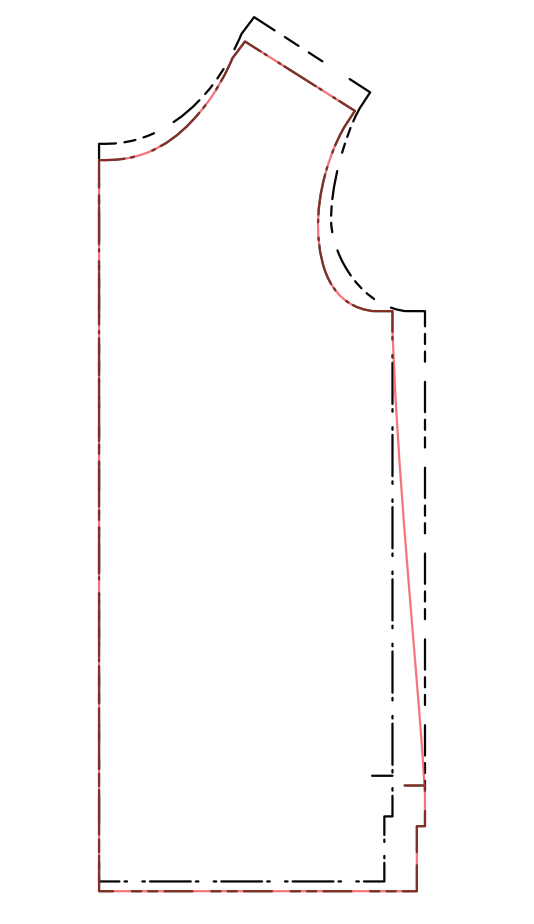
Example: grading a top
The image below shows a tank top pattern in size 30 and 34 in black, and a new blended size in red. The blended size corresponds to size 30 at the chest and size 34 at the hip. Note that the target sizes are matched at the sewing line; no blending happens within the seam allowances. The center front and center back lines are not changed, except the vertical length is matched to size 30 at the neckline and size 34 at the hip.
Example: grading pants
The image below shows a pants (trousers) pattern in size 40 and 44 in black, and a new blended size in red. The blended size corresponds to size 40 at the low/full hip and size 44 at the high hip (it's actually slightly wider than size 40 at the hip; this is to make the side seam curve smoother, and to allow the pants to hang down more freely from the high hip). The center front and center back rise lines are not changed, except the waistband height is matched to size 44, and the crotch curve is matched to size 40.
.PNG)
Grading "nested" pants sizes
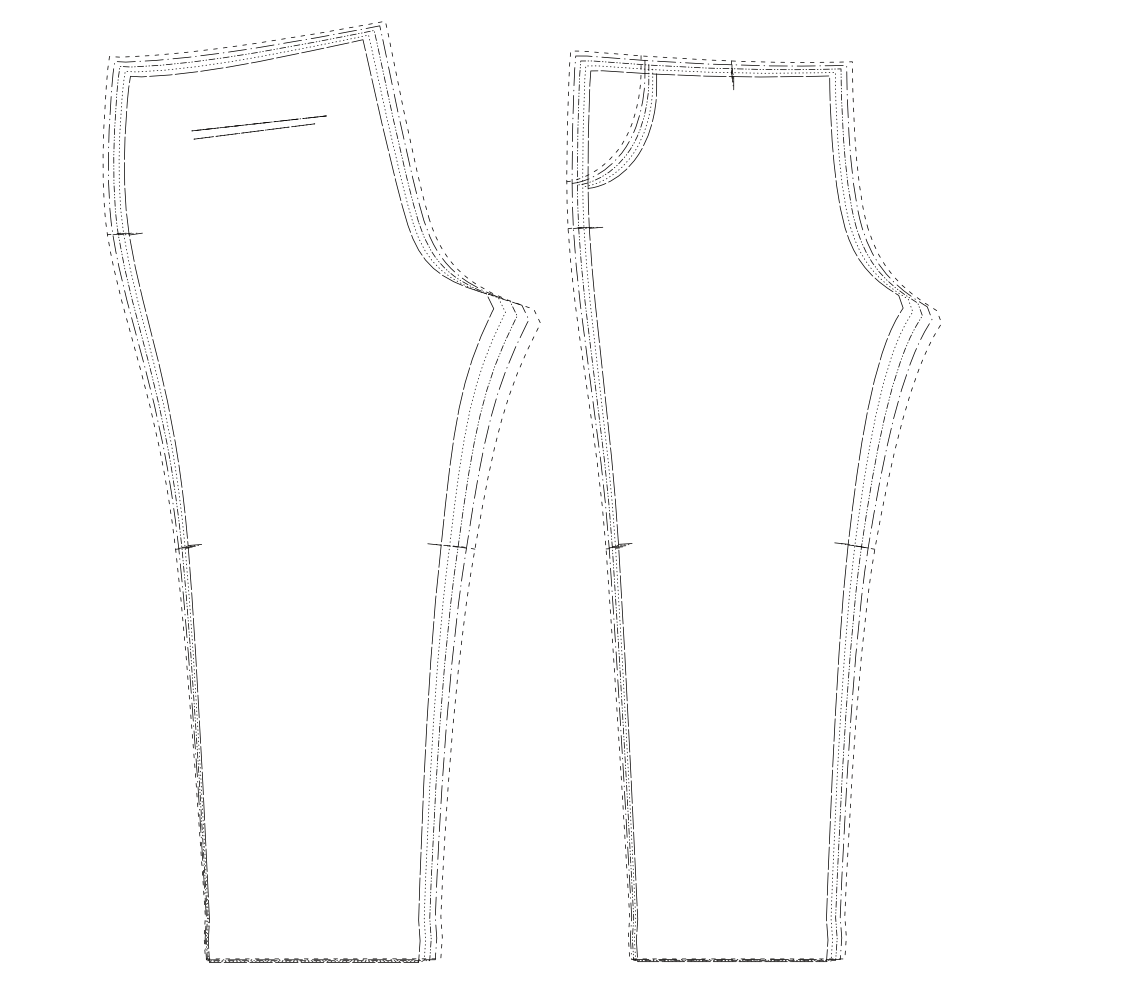
Notice that the above example has both sizes aligned along the center front and center back rise. That's not how most digital patterns arrange the sizes. The sizes are typically "nested" one inside another to minimize the amount that the lines overlap, so that you can see the line corresponding to your size clearly. Here's how size 40 through size 48 look in the Scarlet Elastic-Waist Pants pattern:
If you grade from a size 40 hip to a size 44 high hip, without accounting for alignment, you might come up with this (the new blended size, in red, is the same in both images below; the one on the right shows it without the original pattern so we can see it more clearly):
.PNG)
.PNG)
Don't do this (unless you are altering the crotch fit on purpose)! It changes the shape of the crotch curve, which is typically considered a completely separate fit alteration from blending sizes, and can cause issues if not done on purpose: the center front in particular in this example is now curved outward instead of more-or-less vertical, which can give the crotch curve weird shaping, and also makes zipper fly installation difficult.
Instead, you can approximate the original example by making use of other sizes. In this case, we are grading the high hip up 2 sizes, and we want to expand the pattern only at the side seam. We can get the same effect using the nested pattern by grading up 4 sizes at the side seam, and zero at the center front/center back. The image below shows sizes 40, 44, and 48 in black, and the new blended size in red (copied on the right by itself so we can see it more clearly).
.PNG)
.PNG)
Note that size 44 is still used for the vertical position of the waistband seam.
How well does this method work? The image below shows the blended size from the original example (where size 40 and 44 are aligned at center front and back) in blue, and the blended size using size 48 at the side seam in orange. They match almost perfectly, except the back rise is very slightly higher (about 3mm) in the original example, and the front pocket is different. Since the front pocket doesn't affect fit, and you will need to re-draw the front pocket pattern to match your new blended size anyway, that's fine.
.PNG)